The Process Portfolio: Evidence of Learning That Survives Generated Text
A finished essay used to certify two things at once: that a student could produce it, and that the producing had taught them something. Generated text has broken that double duty. A competent product can now be obtained without the cognitive events it was meant to imply, and no inspection of the product restores the inference. The reliable evidence has moved to the process, and a school needs a container for it.
The process portfolio is that container. It is older than the written examination and was designed for the situation schools now face: judging a learner when the final artifact cannot be trusted to speak for the work behind it.
The short answer. A process portfolio is a dated collection of the work behind a piece of work: plans, drafts, notes, sources consulted, a disclosure of any assistance, and a short reflection, sampled with a brief oral check. It evidences learning because it shows thinking happening over time, and it evidences authorship for the same reason.
Where the process portfolio came from
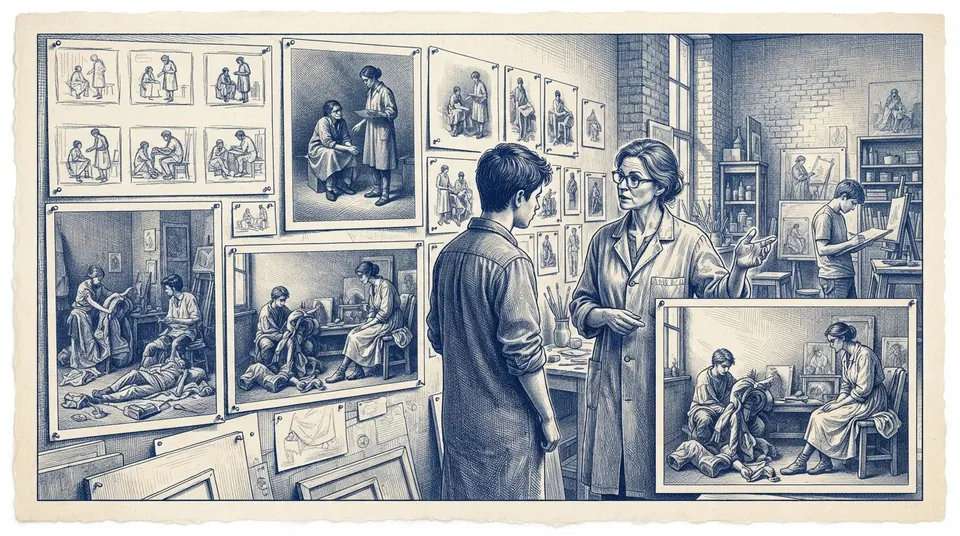
Art schools never graded a painting sight unseen. The studio tradition assessed the sketchbook and the abandoned studies, because a tutor who had watched a hand develop could judge what the canvas meant. Architecture schools built the same logic into the crit, where a student defends a design before a panel that has seen the earlier iterations pinned to the wall. Authorship was never in doubt, because the making was observed.
The 1990s portfolio assessment movement tried to bring this logic into general schooling at scale, hoping that portfolios scored against public rubrics could replace the multiple-choice test for accountability. Vermont ran the boldest experiment, adopting statewide portfolios in writing and mathematics from 1991. RAND evaluated it, and the findings of Koretz, Stecher, Klein and McCaffrey, 1994 are the honest starting point: agreement between raters scoring the same portfolios was poor in the first year, too low to report school-level results, and the evaluators concluded that the programme had largely failed as a source of comparative data while showing promising effects on classroom instruction.
That split verdict is the lesson. Portfolios were weak as a standardized measurement because tasks varied between classrooms, and strong as a record of what happened in one classroom, read by the teacher who set the work. The process portfolio asks only the second thing of them.
What a process portfolio contains
A showcase portfolio collects best finished pieces and asks a reader to admire them; a process portfolio collects the trail behind a piece and asks a reader to follow it. The components below are what a school can reasonably require for substantial unsupervised work.
| Component | What it evidences | Teacher time per student |
|---|---|---|
| Dated plan or outline | Task framed before writing | Under a minute, existence check |
| Successive dated drafts | Revision over days, not one paste | Two to four minutes to skim |
| Working notes | Engagement with sources | Existence check |
| Sources, with what was taken | Provenance of ideas and quotations | One to two minutes |
| Disclosure of assistance | What help was sought, kept and rejected | One minute |
| Reflection, 150 to 300 words | The student's account of what changed and why | Two minutes; richest formative item |
| Version history export | Timestamped corroboration of the drafts | Under a minute |
| Sampled oral check | Command of the process; hardest to fake | Three to five minutes, sampled |
The disclosure is the item schools most often omit and most need, because it turns the use of a language model from a hidden act into a documented decision; our guide to writing an AI disclosure statement for coursework gives students the form. The export is corroboration rather than the heart of the portfolio; the companion piece on version history as evidence of authorship explains what it can and cannot show. A paper folder satisfies every other row.
Grading a process portfolio without drowning the teacher
The objection that stalls portfolios is arithmetic. A teacher with 150 students cannot read 150 draft trails in depth. Three rules keep the workload inside a working week.
Skim for existence, not quality. A dated outline, two or more drafts and a source list are checked in under a minute per student. A trail that exists is doing most of its work simply by existing, because a student who knows it will be looked for produces it, and producing it requires the thinking to happen.
Grade a sample. Each cycle a handful of portfolios per class are read in depth, chosen so no student can predict whether theirs is among them. The sampled portfolios receive full formative comment and the short conversation described in our article on the oral exam and viva voce; the rest receive the existence check and a grade anchored to the final piece. The incentive travels with every submission.
Weight the trajectory. Where marks attach to the portfolio, they attach to the distance travelled between first plan and last draft rather than to the polish of the final artifact. A machine can supply a finished essay, but not a student's own believable trajectory towards it, and a trajectory manufactured after the fact reads as such in a three-minute conversation.
Why the portfolio doubles as evidence of authorship
The same folder is a student's best defence when authorship is questioned. Detection software is a weak witness: it estimates fluency statistics and calls the estimate a verdict, and Liang and colleagues, 2023 found that widely used detectors flagged a majority of essays by non-native English writers as machine generated while passing native speakers' work. A student so accused has no way to prove a negative. A student with a process portfolio does not need to. The dated plan, the drafts with their crossings-out, the source notes, the disclosure written before any question was raised, and a corroborating version history together form evidence of work that a tribunal can weigh.
This reverses the burden fairly. Teachers stop being asked to infer authorship from artifacts that can no longer support the inference. Students who did the work hold the proof as routine rather than as emergency reconstruction, the situation described in our article on what a student can show when falsely accused of using AI. The few who did not face a plain question: where is the trail? A policy built on the process portfolio can drop detection scores from its evidentiary standard, as this publication recommends.
The lineage: making thinking visible
The process portfolio is the apprenticeship principle applied to evaluation, which is why it serves learning as well as integrity. The Initiative's flagship essay by Collins, Brown and Holum on cognitive apprenticeship and making thinking visible argued in 1991 that expertise is transmitted when the expert's processes are externalized for the novice to observe, and the novice's processes made visible for the expert to correct. A master carpenter assessed a chair by having watched it built; judging and teaching were one act of watching, as Master and Apprentice describes. Schools separated the two for efficiency; the portfolio is the cheapest way of putting them back together.
Formative assessment research arrives at the same place by a different road. Black and Wiliam, 1998, reviewing some 250 studies for Inside the Black Box, reported effect sizes between 0.4 and 0.7 for formative assessment, among the largest found for any educational intervention. Their mechanism was feedback on work in progress, which requires the work to be visible. A process portfolio is that visible work, dated and in one place, and the authorship evidence falls out for free. Our essay on proof of work when product severs from process sets out the general case; the portfolio is its working form. Proportionality still applies: low-stakes practice can tolerate ambiguity, certifying assessments cannot, and homework, the largest mass of unsupervised work a school assigns, is where the trail matters most.
Frequently asked questions
What is the difference between a process portfolio and a showcase portfolio?
A showcase portfolio collects finished pieces chosen to display achievement and is read for their quality. A process portfolio collects the plans, drafts, notes, sources, disclosures and reflections behind a piece of work and is read for the trajectory of thinking. Only the second evidences how the work was made.
How much teacher time does a process portfolio take?
Far less than its reputation suggests, if the school skims for existence and grades a sample. An existence check takes under a minute per student. Reading a sampled portfolio in depth, with a three-minute oral check, takes perhaps ten minutes, and only a handful per class are sampled each cycle.
Can a student fake a process portfolio with a language model?
A student can generate fake drafts, but a manufactured trail rarely survives the combination of dated files, a version history that corroborates them, and a short conversation about why the second draft changed. The portfolio does not make dishonesty impossible; it makes it more laborious than doing the work.
Should the process portfolio replace the final grade?
No. The final piece is still assessed on its merits. The portfolio supplies the evidence that the piece was learned as well as produced, carries a share of the marks tied to the trajectory, and stands as the record if authorship is questioned. Making it the whole grade repeats Vermont's mistake.
Where this leaves a school
A school that adopts the process portfolio has answered the two questions generated text raised in a single move. It can see the learning, because the thinking is on the table in dated form, and it can settle authorship, because the same trail is evidence of work that no detector can supply and no accused student should have to reconstruct. The instrument is old, its limits are documented, and its costs are manageable if the teacher skims for existence, grades a sample and weights the trajectory. The Academic Integrity hub treats the components in turn; readers writing the policy should turn next to the working template for an academic integrity policy for AI.
For media and design work, where the portfolio holds images rather than drafts, Content Credentials for student work describes the signed provenance record that can sit alongside it.