The Oral Exam Returns: Viva Voce as Proof of Learning
The oral exam is older than the written one by several centuries, and for most of that time nobody thought of it as an authorship check, because there was no other kind. A student who could not explain an argument in front of a master had not made it. The nineteenth century replaced that direct observation with the marked script, for reasons of cost and scale, and schools have lived inside the written product since.
Generated text has now removed the assumption on which the written product rested: that a competent essay implied a competent student. As this publication argued in assessment when product severs from process, the finished artifact no longer certifies the thinking behind it. The viva voce never depended on that link.
The short answer. An oral exam evidences learning by asking the student to reconstruct, defend and extend their own work in conversation, which no generated text can do on their behalf. Run as short sampled checks against a shared question bank and rubric, it costs a few minutes per student and supplies evidence of authorship that no detector can.
The oldest authorship check there is
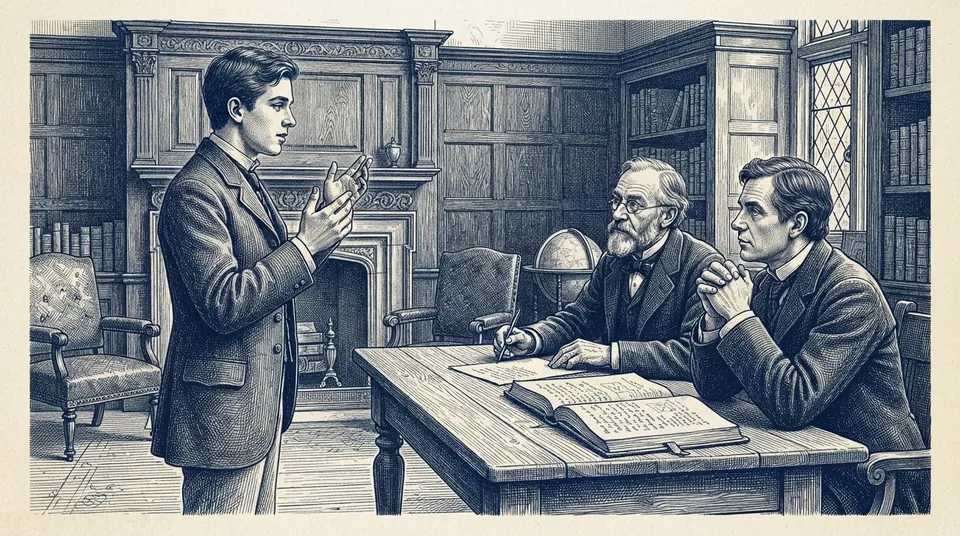
The medieval university examined by disputation: a candidate advanced a thesis and defended it in public against objections from masters and fellow students. The doctoral viva voce, in which a committee questions a candidate on a thesis for hours, descends directly from that practice. The Oxford tutorial belongs to the same family, a student reading an essay aloud to a tutor who interrupts and presses, and behind all three is the Socratic method, a claim tested by questioning until its owner sees what it commits them to.
The common feature is that the person is examined and the paper is incidental. Collins, Brown and Holum argued in 1991 that expert thinking has to be made visible before an apprentice can learn it; our restored essay on cognitive apprenticeship and making thinking visible sets out that argument. The viva applies the same principle at the point of judgment. A master who watched an apprentice work never needed to ask whether the chair was the apprentice's own; the account of how apprenticeship transmits judgment in Master and Apprentice explains why. Watching and assessing were one act.
Why the written exam displaced it
The written examination won on arithmetic. An oral needs one examiner, one candidate and a block of time per head, and leaves no record a second reader can check. A written paper can be set once, sat by hundreds, marked against a scheme, appealed and archived. Historians of assessment generally place the decisive shift in the nineteenth century, when growing university enrolment, competitive examinations for the reformed British civil service after 1854 and mass schooling demanded an instrument that scaled. The artifact served as a proxy because there was no way to obtain a good essay except by being able to write one. The oral exam was not defeated. It was priced out.
What generated text changed
A language model now produces competent prose on almost any school topic in seconds, and the first institutional reflex, running submissions through a detection service, has not restored the proxy. The sibling article on how accurate AI detectors are reviews the evidence: detection yields probabilities, misfires on non-native writers and is defeated by paraphrase. The reliable evidence of authorship lives in the process. Drafts, version history as evidence of authorship and the process portfolio record the work as it happened. The oral exam is the member of that family that lives in the student's head. It cannot be pasted, and it alone tests whether the student can still do the thinking today.
What an oral exam evidences beyond authorship
The viva is also a learning event. Roediger and Karpicke showed in 2006 that being made to recall material strengthens retention far more than restudying it: students who studied a passage once and were tested three times recalled about 61 percent of it a week later, against roughly 40 percent for students who studied it four times, a result reported in Test-Enhanced Learning. An oral check is retrieval practice with a questioner who can follow up, the closest assessment to what Black and Wiliam's 1998 synthesis called looking inside the black box, and because it poses questions the student did not prepare for, it evidences transfer, which written coursework is worst at showing.
Running the oral exam without killing the timetable
A twenty-minute viva for every student on every assignment would consume the term. Four moves answer that.
Sample. If any submission might be the one discussed, the incentive travels with all of them. A fifth of a class at random, twice a term, keeps the expectation universal and the cost small.
Keep it short. A three to five minute "walk me through" check is enough: reconstruct the main claim without the text, say what was rejected on the way to it, extend the argument to a case the work did not cover.
Use a structured question bank. Write questions at four levels for each assignment: reconstruct, justify, extend and transfer. Publish the levels in advance, keep the specific questions to the examiner, and draw from the same bank across every group.
Consider the interactive oral. Australian universities have developed a format that replaces the quiz with a role-played professional conversation: the student briefs a client or defends a design decision, and the examiner plays the other party. Sotiriadou and colleagues at Griffith University reported in 2020 that it deterred contract cheating and developed employability skills, in Studies in Higher Education. The Quality Assurance Agency lists oral and interactive assessment among practical responses to generated text in its generative artificial intelligence resources.
| Format | Time cost per student | What it evidences | Fairness risks |
|---|---|---|---|
| Full viva (20 to 45 minutes) | High; realistic only for capstones and theses | Authorship, depth, transfer, defence under sustained questioning | Highest anxiety; examiner style varies; hard to moderate unrecorded |
| Sampled defence (3 to 5 minutes, random subset) | Low; about one lesson per class per term | Authorship of the specific work and command of its reasoning | Selection must be visibly random to avoid the appearance of targeting |
| Interactive oral (role-played scenario, 10 to 15 minutes) | Medium; needs a scenario script and examiner training | Authorship, applied understanding, professional communication | Rewards confident speakers; high language load |
| Recorded explanation (short filmed walkthrough) | Very low; reviewed asynchronously | Familiarity with the work and ability to narrate it | Can be scripted or coached; weakest of the four |
Fairness questions to settle first
Oral exam anxiety. Some students freeze in conversation who would have written well, and the anxiety is no evidence about authorship. It falls when the format is ordinary: practise low-stakes orals from the first week, publish the question levels, let students bring their work into the room. A school that uses the viva only when it suspects someone has taught its students that being asked is an accusation.
Language. A non-native speaker who understands their argument may explain it haltingly, and a fluent speaker may perform understanding they lack. The rubric must score substance and ignore delivery; the examiner should reformulate rather than repeat, and let the student point to the text or draw. The bias that makes detectors flag non-native English writers will reappear in an untrained examiner unless the rubric forbids it.
Disability adjustments. Extra time, questions in writing as well as speech, a typed exchange, a familiar examiner or a recorded response each change the channel while preserving the core requirement: that the student, and not a machine, reconstructs the reasoning.
Consistency across examiners. The remedies are the ones every examination board already uses: a shared question bank, a short rubric, a calibration session in which examiners score the same recorded oral, and a recording or second examiner for any oral that affects a grade or misconduct finding. A student falsely accused of using AI needs the oral to be their strongest defence, which requires documentation and moderation.
Frequently asked questions
What is a viva voce examination?
Viva voce is Latin for "by the living voice." It names an examination conducted by spoken question and answer, in which the candidate explains and defends work they have submitted. The doctoral viva is the best known form, but the method serves coursework at every level, from a five-minute essay check to a capstone defence.
How long should an oral exam be?
Long enough to tell whether the student commands the work, which is usually shorter than teachers expect. A sampled check of three to five minutes is sufficient for authorship and reasoning. An interactive oral runs ten to fifteen minutes. Full vivas of twenty minutes or more belong to theses and capstones.
What questions are asked in a viva?
Good viva questions ask the student to reconstruct the argument without the text, justify a choice they made, extend the idea to a case they did not cover, and apply it somewhere new. Examples: "Summarise your main claim in two sentences." "Why that source rather than the obvious one?" "What would change if the sample doubled?"
Can an oral exam replace AI detection?
It can replace the role detection was asked to play, which is establishing authorship. A detector estimates whether prose has the statistical shape of machine text; an oral shows directly whether the student can reproduce and defend the thinking. It should be routine and sampled, never triggered by a detector score alone.
Where this leaves a school
The oral exam was displaced because the written product was cheaper and, for a century and a half, a good enough proxy for learning. Generated text has ended the proxy, and the older instrument was waiting. A school does not need to interview every student on everything. It needs a sampled, structured, rubric-scored oral check to be an ordinary part of how learning is evidenced. That is the position of the Academic Integrity hub throughout: authorship is established by command of the process, and the viva voce is the purest test of it. The companion piece on authentic assessment when the product can be generated is the next step.
The oral check also answers the question a reader's intuition cannot, which is the subject of whether teachers can detect AI writing unaided, and it is the one form of evidence that contract cheating in any of its forms has never been able to counterfeit.