Version History as Evidence of Authorship
When a teacher suspects that an essay was not written by the student whose name sits on it, the finished text offers almost nothing to go on. The one artefact that records how the work came to exist is the document itself. Version history in Google Docs, and its counterpart in Word for files stored in OneDrive or SharePoint, preserves the sequence in which text appeared, grew, was cut and was rearranged. That sequence is the closest thing most schools have to a record of composition, and few ever open it.
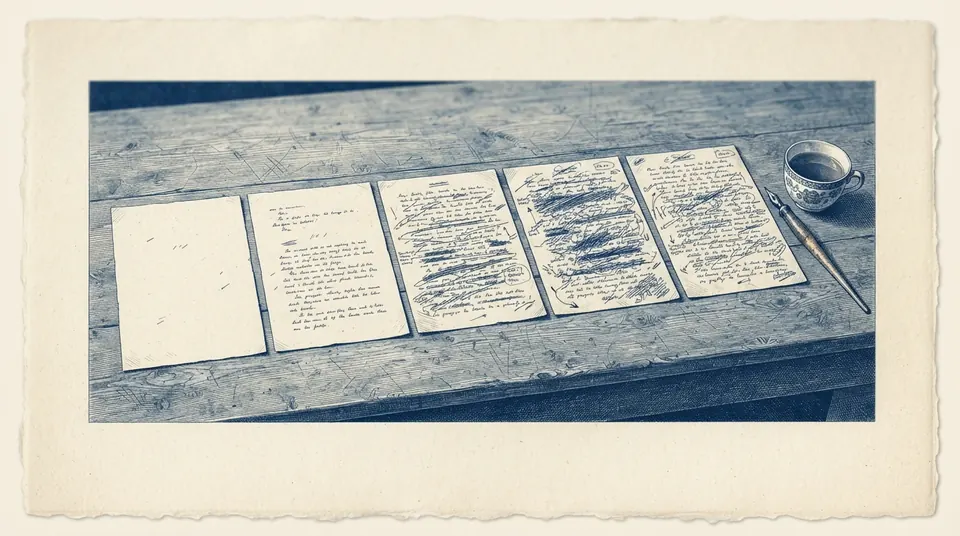
The record is imperfect. It can be gamed by retyping, it exists only when the writing happened inside a synced document, and it records keystrokes, never understanding. Even so, it is a better witness than a probability score from a detection service, because it describes what happened rather than estimating what a text resembles.
The short answer. Version history is a timestamped record of how a document changed and which account changed it. Read in two minutes, it distinguishes composition over hours or days from a single large paste. It cannot show where pasted text came from, or that the student understood it, so it is one layer of process evidence, never proof on its own.
Version history in Google Docs and Word: what it records
Google Docs keeps an automatic history of every edited document, reached from the File menu. Google's guide to the feature describes what a reader sees: a panel listing versions by date and time, each attributed to the account that made the edits, with a "show changes" toggle that colours added text by editor. Two features matter more for authorship than the automatic log: an editor can name the current version ("outline, Tuesday", "first full draft") so that it persists as a fixed point, and the per-editor colouring shows whether one account did the writing or text arrived under another name.
Word offers an equivalent for any document saved to OneDrive or SharePoint with AutoSave on. Microsoft's page on viewing previous versions sets out the route: File, then Info, then Version History. Each version shows a date, a time and the saving account, and can be opened, compared or restored. A Word file kept on a local drive and emailed as an attachment has no history at all.
What an honest composition trail looks like
Composition has a recognisable shape in a history. An essay written over a week usually begins with fragments: a title, a bulleted plan, a first paragraph that later disappears. Word count grows unevenly across sessions. Sentences are cut and restored. Paragraphs move. The final version follows a stretch of small edits in which the count barely changes. Bereiter and Scardamalia described mature writing in 1987 as knowledge transforming, the text forcing the writer to reorganise what they know, and its history looks like reorganisation.
A generated essay pasted in looks like none of this. The document is empty, then in one version it holds seven hundred finished words. The shape is a step rather than a slope, and it is the most legible thing a history can show. But a student who drafts by hand and types up the result, or who dictates, produces a paste-like history too, so the step is a reason for a conversation, and only that. The site's statement on assessment when product severs from process makes the general case: process evidence supplies a reasonable basis for a follow-up, never a verdict delivered by a screen.
How a student names versions and exports a record
A student who expects their trail to be read can make it easy to read, at a cost of a few minutes per assignment.
- Write in one document from the first note to the final submission, rather than moving text between files.
- Name a version at each natural stage: plan, first draft, revised draft, final. In Word it is enough that the file lives in OneDrive with AutoSave on.
- If any text is brought in from elsewhere, including notes typed from paper or permitted machine assistance, say so in a comment where it appears and in a disclosure statement.
- Before submitting, confirm the named versions are present and make a copy of the earliest substantive draft as a separate file: the exportable record if the original is ever locked or deleted.
Students who keep this record hold the material described in what a student can show when falsely accused. The habit also serves the writing: a student who can see their own draft moving has been shown that revision is the work, the oldest lesson of cognitive apprenticeship, which makes the invisible process observable so that it can be taught.
How a teacher reads a history in two minutes
No surveillance software is needed. Keystroke recorders watch the student harder to make an unsupervised product trustworthy; version history was already there.
- Open the history panel. How many sessions, over how many days?
- Step to the earliest version with real content. Is it a plan or a fragment, or the finished essay?
- Step forward and watch the word count. Does it climb across sessions, or jump once?
- Turn on "show changes", or compare two Word versions. Is the final stretch made of small edits to the student's own sentences?
A slope, several sessions and late small edits are consistent with authorship. A step invites a conversation, ideally the three-minute check described in the oral exam as proof of learning: walk me through this paragraph and what you rejected. Sampling is enough; if any submission might be the one opened, the incentive travels with all of them.
What a history shows and what it cannot show
| The history can show | The history cannot show |
|---|---|
| When text appeared, and in what order | Where pasted text came from |
| Whether the document grew over sessions or arrived at once | Whether a slope was produced by retyping generated text |
| Which account made each change | Who was sitting at the keyboard |
| That named versions were kept at stated stages | Whether the student understood what they wrote |
| That late edits were small and local | Whether ideas were dictated from another screen |
The right-hand column is why version history is a layer rather than a proof. A determined student can retype a generated essay over three evenings and produce a slope. Students on a shared household computer may write in whatever application is available, and a rule that demands a Google Docs history penalises them for their circumstances. The same rule misreads a student who drafts in a first language and translates, the population detection services fail most often: Liang and colleagues showed in 2023 that automated detectors flagged most essays by non-native English writers as machine generated, and a school that replaces one unfair instrument with a rigid version of another has learned nothing.
Ask for the trail, not the verdict
Run a detection service and the school receives a number, unexplainable and wrong often enough that it should never ground a finding, as the review of how accurate AI detectors are sets out. Ask for the trail and the school receives a record the student made, can explain and can be questioned about. The first outsources judgment to an estimate; the second returns it to the teacher and the student.
The request belongs in the assignment brief, before any suspicion forms. A policy that says "substantial written work is composed in a synced document and the history is part of the submission" makes the history an expected artefact rather than a search warrant, and needs an honest exception for students who cannot meet the storage condition. Applied to the unsupervised writing the site's review of the homework question describes, this is more work in policy and less in practice than any detector regime.
Frequently asked questions
Can teachers see version history in Google Docs?
Only with edit access to the document; a view-only link does not expose the history. Platforms that distribute assignments as copies of a template usually give the teacher that access; a document created in a student's personal account does not, so the sharing setting belongs in the brief.
Does version history show who typed the text?
It shows which signed-in account made each change, coloured by editor when "show changes" is on. It does not identify the person at the keyboard: a parent who types under the student's account appears as the student. The history is evidence about accounts and timing, and should be described as such.
Can version history prove a student did not use AI?
No. A history can show that text was composed over several sessions and revised in small steps, which is consistent with authorship, but a retyped generated draft produces the same pattern, and no history shows what the student understood. Treat it as one layer alongside a disclosure statement and an oral conversation.
What if a student writes on paper first and types it up?
The history will look like a paste, because it is one. The student should say so in a comment at the top of the document, and the teacher should ask to see the paper draft. Dictation produces the same shape, which is why a step prompts a conversation rather than a finding.
Where this leaves a school
Version history in Google Docs and Word is the cheapest process evidence a school already owns. It costs nothing to keep, takes two minutes to read, and answers the one question a finished text cannot: how it came to be. A school that treats a clean history as proof, or a step-shaped one as guilt, has misread the instrument as badly as the school that trusts a detector.
Authorship is demonstrated by command of the process, and the record of that process should be requested openly, before the work begins, from every student on equal terms. The Academic Integrity hub gathers the other layers, and the process portfolio as evidence of learning shows how version history, disclosure and an oral check combine into a record that outlasts any writing machine.
Where the work is an image or a video rather than a document, the equivalent trail is a signed manifest; Content Credentials in the classroom explains what it records. And a student who used a tool honestly should say so in the form the style guides expect, set out in how to cite AI assistance.